
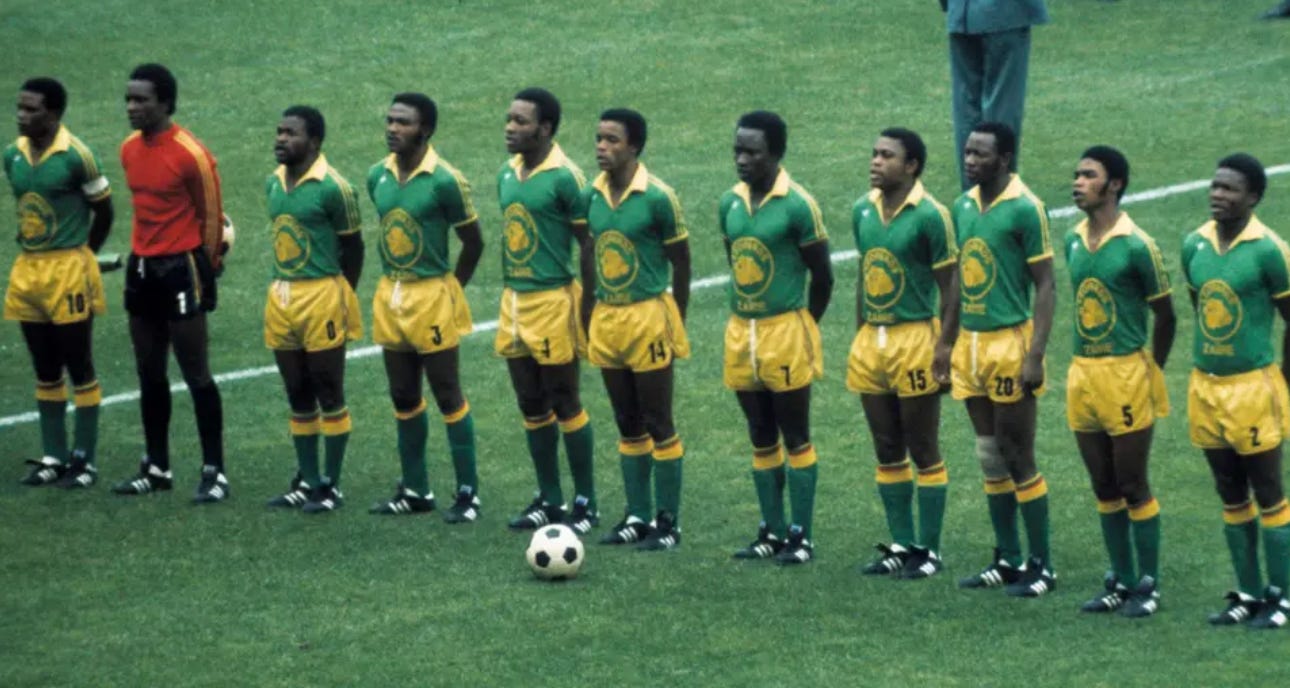
The Democratic Republic of Congo was a sight to admire on the football pitch. It came within some 20 minutes of knocking England out of the competition, succumbing to two late goals by Harry Kane. Before that, it held top-class Portugal to a 1-1 draw, comfortably defeated Uzbekistan and almost held back Colombia, a contender to take the cup home.
The contrast couldn’t be starker with Congo’s previous visit to the World Cup. That was more than half a century ago, in 1974, when the country was called Zaire; ruled by the infamous kleptocratic despot, Mobutu Sese Seko. The adventure ended with a deficit of 14 goals, having lost 0-2 to Scotland, 0-9 to Yugoslavia and 0-3 to Brazil.
A bizarre moment from Zaire’s match against Brazil made it into the history books: when defender Mwepu Ilunga darted out of the wall that Zaire set to defend a free kick to be taken by Brazil’s Rivellino and kicked the ball far upfield. Apparently, Mobutu had warned players that they would never see Zaire or their families again if they conceded more than 3 goals. Ilunga freaked out.
No such threat hung over the players during Congo’s more joyful experience of football this month. Welcome though this is, though, it’s depressing to witness how footballing progress is divorced from the broader concept of progress with which we assess the evolution of humankind.
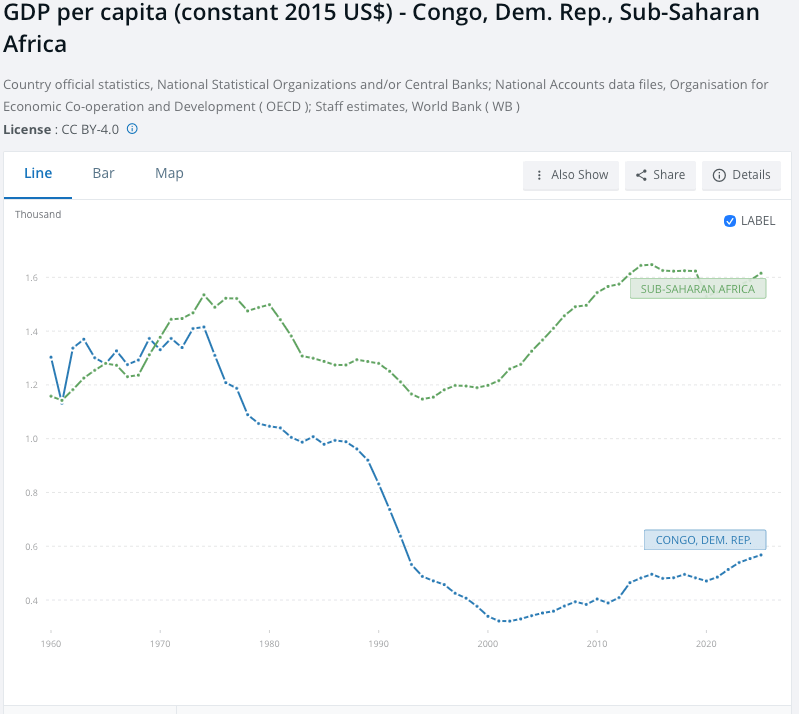
In Mobutu’s day, Zaire’s Gross Domestic Product per person amounted to about $1,970, in today’s money, according to the World Bank. Last year, the Democratic Republic of Congo’s GDP per capita barely hit $790 by the same measure–putting it toward the bottom among its neighbors: GDP per capita across Sub-Saharan Africa averages almost $2,250.
Rich in critical minerals, the Congo has been ripped apart by war since Mobutu’s time. Ethnic conflict in the east between Hutus and Tutsis–largely financed by neighboring Rwanda–has led to approximately 6 million deaths.
The war dislodged Mobutu from power in 1997. But that brought no end to war or political strife. Laurent Kabila, Mobutu’s successor, was assassinated a few years after coming to power. Félix Tshisekedi, the current president, was elected. Still, clouds hang over the legitimacy of that vote, and Mr. Tshisekedi is trying to stretch the law to allow himself a dubious third term in power.
To top off the historical arch, the Democratic Republic of Congo is going through its 17th outbreak of Ebola. 1,333 people had died of the disease by June 29, according to statistics by Congolese health authorities.
My understanding of Congo’s economic, social and political evolution since the 1970s is, admittedly, meager. I suspect the “resource curse” has to do with Congo’s travails. Its mineral wealth has drawn foreign powers–these days China is the major one–to hoover up its natural riches, fuelling corruption at all levels of governance.
Still, the contrast between the evolution of Congolese society and the achievements of its children on the football pitch underscores how sporting success does not build prosperity. If the Congolese had advanced in math as much as they’ve progressed in football, I suspect the country might be doing better.
This is a superficial thought, sure. I do not intend to put down sports. I am a passionate supporter of Mexico. I experienced the post-game craziness at the Angel of Independence roundabout on Reforma boulevard the other day. But I want to reflect about what sport contributes to a society’s wellbeing.
Sport has long been understood to be a path for poor kids to achieve prosperity. The top sides at the World Cup are populated by the children of the inner cities, the favelas, the banlieues, the children of impoverished immigrants from former colonies. One in 12 players at the World Cup were born in France. This speaks to colonial France’s dominance over much of Africa, where many families understand football as a path for their children out of poverty.
It’s not that these families are necessarily making a wrong choice. Talented kids have built enormous fortunes upon their footballing prowess. But I’m guessing that most fail to turn their skills into a decent living.
Maybe this is an irrelevant observation. Why not nurture kids’ passion and talent for football? Maybe they make it big. Maybe not. But I wonder about the role of sport in society. It’s hard to shake the image of wealthy spectators (and FIFA has made sure that only the wealthy can afford the spectacle) jangling their pearls as the children of their maids and gardeners perform wonders on the pitch.
The Congo has been in a continuous state of suffering since the incredibly brutal Belgian colonization and rape of their natural resources, mainly rubber and precious metals. This benighted country has never had peace or prosperity because they have always been slaves to whichever tinhorn dictator had the reins of power at any given time. It's remarkable they were even able to field a team!